Work Moved Beyond the Perimeter. Security Must Follow.
Employees now conduct sensitive business from environments the organization does not physically control. A secure enterprise architecture must therefore protect the endpoint and the communication wherever the employee operates.
Where enterprise mobility breaks down
The device that carries a corporate identity also carries the messages, the files and the network the employee happened to join this morning.
What ASPIS Protects
What the platform does
Drawn from the ShieldiT Enterprise and ShieldiT Protect white papers. Availability varies by edition and configuration.
Encrypted communications
- End-to-end encrypted chat, voice, video and media sharing.
- AES-256 with Olm/Megolm protocols and Double Ratchet key management.
- Forward and backward secrecy, so a key compromise does not expose the history.
- Group membership, external federation and file movement follow policy rather than user choice.
Mobile Threat Defense
- On-device AI analysis of device behavior, applications, networks and phishing indicators.
- Phishing detection across SMS, email, in-app links and QR codes.
- Malicious and non-compliant application identification through on-device heuristics.
- Rogue access point, spoofed network and man-in-the-middle detection.
- Continuous device risk posture monitoring, including OS integrity.
Administration and governance
- Centralized administration of communications, device security and policy through the ManageiT console.
- AuditBot logging of device events, user activity and policy enforcement.
- Policy enforcement and threat remediation issued directly from the console.
Fits the estate you already run
- Identity: Entra ID / Azure AD, Okta, Google Workspace and SAML/OIDC for single sign-on and role-based access.
- Endpoint management: coexistence and policy synchronization with Intune, Workspace ONE and MobileIron.
- Security operations: telemetry and incident forwarding to SIEM and XDR platforms.
- Compliance: export into Microsoft Purview and comparable archives.
Capability availability varies by edition, configuration and deployment model.
Enterprise Security Architecture
What the platform actually looks like.
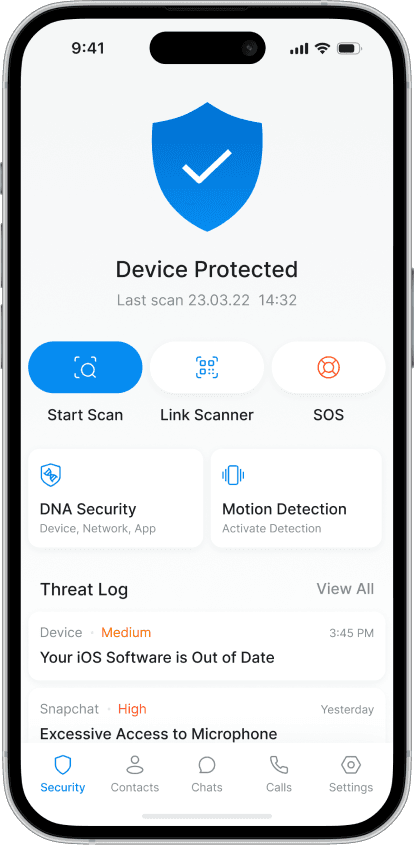
Device posture, evaluated continuously.
The endpoint reports its own condition before it is allowed to carry sensitive communication. Scan history, threat log, and device state are visible to the employee and to the administrator at the same time.
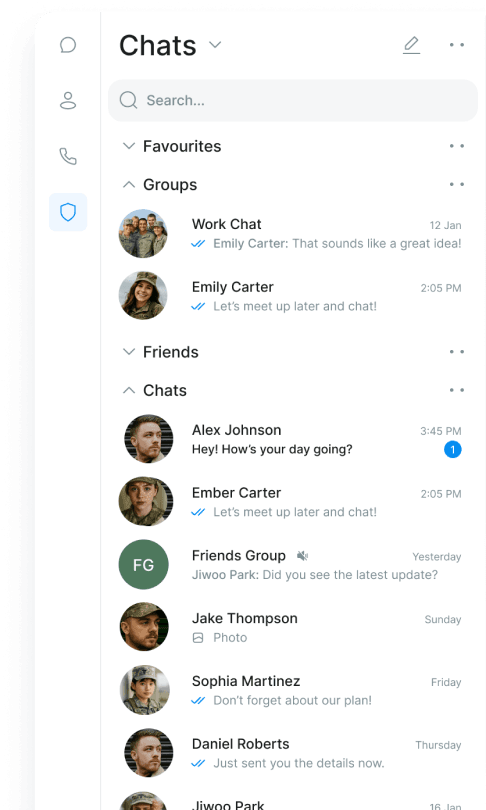
The same conversation, on every endpoint.
Messaging, groups, calls, and file exchange across desktop and mobile under one enterprise identity. Group membership, external federation, and file movement follow organizational policy rather than user choice.
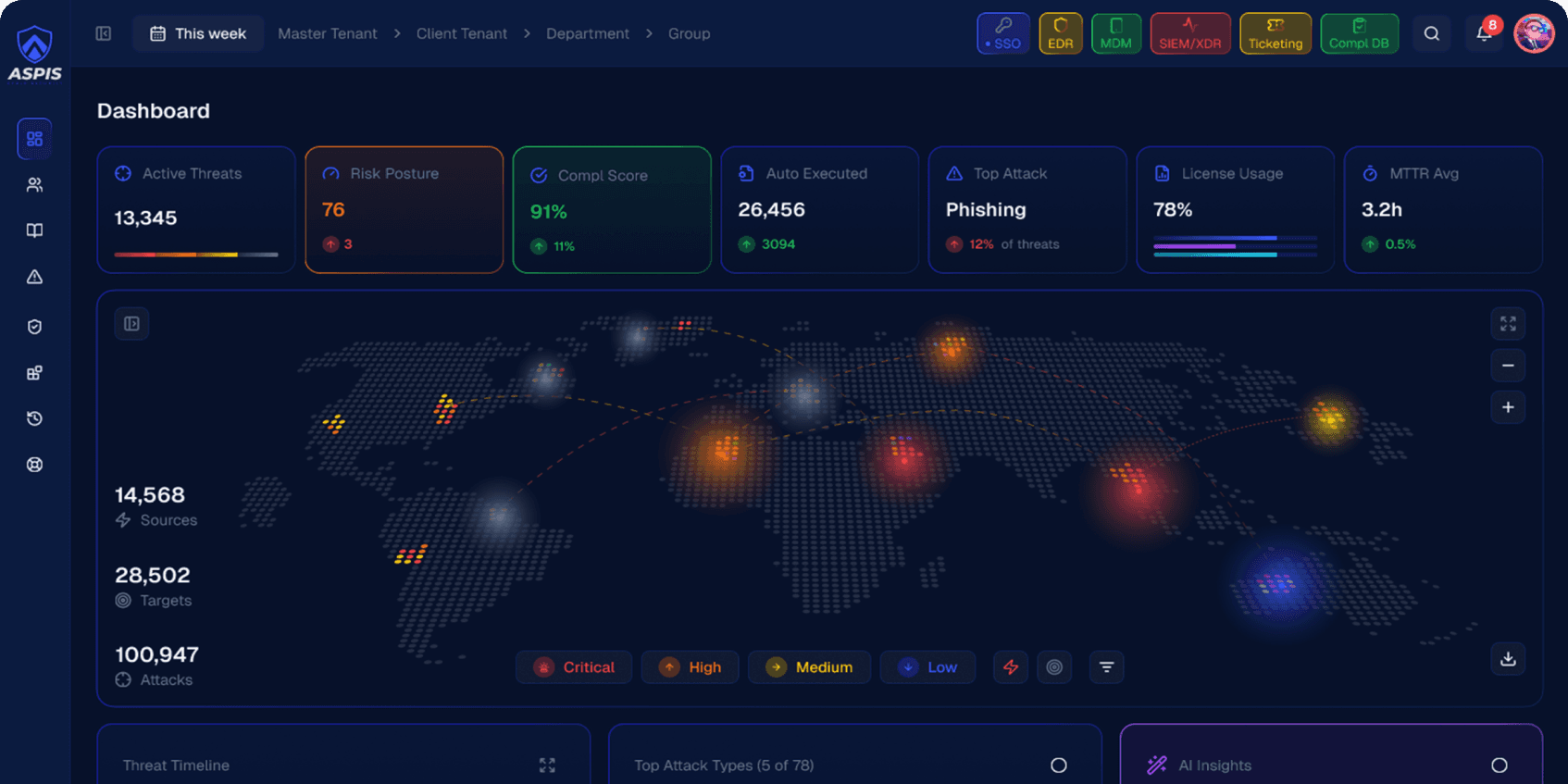
What the security team sees.
ManageiT gives the administrator active threats, risk posture, device inventory, policy state, and license usage across the estate — the operational half of the same architecture the employee is using.
The frameworks this page speaks to.
ASPIS supports customer programs aligned with these frameworks. Coverage depends on edition, configuration and deployment model; the obligation to demonstrate compliance remains with the customer.
SECURITY & TRUST →What the architecture is designed to achieve
Design intent, not measured results. What any given organization sees depends on its estate, its policy and how it deploys.
These describe what the architecture is designed to do. ASPIS makes no representation about results in any particular environment.
The documents behind this page.
Published ASPIS material. Tell us who you are once and every document opens.